



Evita


Memorabilia Available
Evita
by Andrew Lloyd Webber, Tim Rice
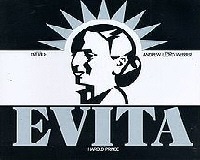
Evita is a musical production, with music by Andrew Lloyd Webber and lyrics by Tim Rice. It concentrates on the life of Argentine political leader Eva Perón, the second wife of Argentinian president Juan Perón. The story follows Evita’s early life, rise to power, charity work, and eventual death. Evita began as a rock opera concept album released in 1976. Its success led to productions in London’s West End in 1978, and on Broadway a year later, both of which enjoyed considerable success. A major 1996 film of the musical was made, starring Madonna and Antonio Banderas. The musical was revived in London in 2006. Evita has been given numerous professional tours and worldwide productions, and numerous cast albums have been recorded.
History
In 1972, Robert Stigwood proposed that Andrew Lloyd Webber and Tim Rice develop a new musical version of Peter Pan, but they abandoned the project.[citation needed] Rice then heard a radio play about Eva Duarte de Perón and approached Lloyd Webber with an idea for a musical collaboration based on her life. The more Rice investigated Eva Perón, going so far as to travel to Buenos Aires to research her life, the more fascinated he became by the woman; he even named his first daughter after her. The idea of writing a score including tangos, paso dobles, and similar Latin flavours intrigued Lloyd Webber, but he ultimately rejected the idea. Lloyd Webber decided instead to collaborate with Alan Ayckbourn on Jeeves, a traditional Rodgers and Hart-style musical based on the P.G. Wodehouse character, which proved to be a critical and commercial failure.[1] Chastened, Lloyd Webber returned to Rice, and they began developing Rice’s proposed musical. The authors of the 1996 book Evita: The Real Life of Eva Perón claim that the musical was based on Mary Main’s biography The Woman with the Whip, which was extremely critical of Eva Perón.[2] Though Rice praised the Main biography, it was never officially credited as source material. Rice suggested that they create a character known as Ché to serve as a narrator and Greek chorus. It was not his intention to base him on Che Guevara, but when Harold Prince later became involved with the project, he insisted that the actors portraying Ché use Guevara as a role model.[3] In the 1996 film adaptation, the character returned to his more anonymous roots.[4]
As they previously had done with Superstar, the songwriting team decided to record Evita as an album musical and selected newcomer Julie Covington to sing the title role. Released in 1976, the two-disc set included Paul Jones as Juan Perón, Colm Wilkinson as Ché, Barbara Dickson as Perón’s mistress, and Tony Christie as Agustín Magaldi. Lloyd Webber and conductor Anthony Bowles presented the musical at the second Sydmonton Festival before making the recording with the London Philharmonic Orchestra.[5] Prior to its release, they played it for Harold Prince and invited him to become involved with the eventual staging. Prince agreed, commenting, “Any opera that begins with a funeral can’t be all bad”, but he advised them that he could not take on any new commitments for the next two years.[6]
In Britain, Australia, South Africa, South America, and various parts of Europe, sales of the concept album exceeded those of Jesus Christ Superstar; in the United States, however, it never achieved the same level of success. Covington’s recording of “Don’t Cry for Me Argentina” (originally titled “It’s Only Your Lover Returning”)[7] was released in October 1976. It reached #1 on the UK Singles Chart[6] and enjoyed similar success internationally. Dickson’s “Another Suitcase in Another Hall” also became a hit. In the U.S. and UK, respectively, Karen Carpenter and Petula Clark released cover versions of “Don’t Cry for Me, Argentina”.
Lloyd Webber and Rice reworked several elements of the musical before producing it for the stage. Some songs were dropped and some shortened, while others were introduced and some lyrics rewritten. The 1976 album and the stage version featured different versions of the dialogue between Eva and Perón during “Dice Are Rolling.” The earlier version concluded with “Eva’s Sonnet”, during which she reaffirms her vice-presidential aspirations. The stage version of “Dice are Rolling” concluded on a shorter version of the sonnet as Eva collapses due to her worsening illness. Additional lyrics were written for the stage version of “Oh, What a Circus”.
Lloyd Webber and Rice approached Prince again, and he told them that he would be ready to start rehearsals in early 1978. When he began working on the project in May, he changed very little, other than deleting Ché’s rock number “The Lady’s Got Potential”. Prince requested a song he could stage to chart Perón’s rise to power, and Rice and Lloyd Webber responded with the musical chairs number “The Art of the Possible”, during which military officers are eliminated until only Perón remains.[8] Inspired by the murals of Diego Rivera, Prince suggested the proscenium be flanked by artwork depicting the struggles of the Argentinian peasants. He jettisoned the original monochromatic costumes designed for the chorus members and dancers; instead, he had them go to charity and secondhand clothing shops to purchase costumes.[9]
Evita opened in London’s West End on 21 June 1978, and on Broadway the following year.
Productions
Original London Production
Evita opened at the Prince Edward Theatre on 21 June 1978 and closed on 8 February 1986, after 2,900 performances.[19] Elaine Paige played Eva with David Essex as Ché and Joss Ackland as Perón.[20] Paige was selected from among many hopefuls, after Julie Covington declined the role. The production was directed by Harold Prince, choreographed by Larry Fuller, and produced by Robert Stigwood. Paige was succeeded by Marti Webb, Stephanie Lawrence, Siobhán McCarthy (who had played The Mistress when the show opened), Michele Breeze and lastly Kathryn Evans.[21] Mark Ryan, who had first starred as Magaldi, later assumed the role of Ché.
In his review in The Sunday Times, Derek Jewell called the show “quite marvelous” and described Lloyd Webber’s “ambitious” score “an unparallelled fusion of 20th century musical experience” and Rice’s lyrics as “trenchant” and “witty”. Bernard Levin of The Times disliked it, however, calling it as an “odious artefact … that calls itself an opera … merely because the clichés between the songs are sung rather than spoken” and “one of the most disagreeable evenings I have ever spent in my life”.[22]
Original Broadway Production
Poster for the Broadway production with Patti LuPone in the title roleThe show opened at the Broadway Theatre on 25 September 1979 and closed on 26 June 1983, after 1,567 performances and 17 previews. A young, unknown Patti LuPone starred as Eva, with Mandy Patinkin as Ché and Bob Gunton as Perón. As in the London production, Harold Prince directed with choreography by Larry Fuller. During the run, six actresses alternated playing the title role, in addition to LuPone: Terri Klausner, Nancy Opel, Pamela Blake (matinees), Derin Altay, Loni Ackerman and Florence Lacey (evenings).[23] David Cantor understudied Patinkin and often performed Ché. LuPone has often stated that her time in Evita was an upsetting experience, since she did not know “how to sing the role” and was “receiving no help from the producer or director or writers”. During the run, she received vocal training from a chorus member in the show who taught her how to sing the score properly.
Original Madrid Production
The musical’s Spanish-language version premiered at the Teatro Monumental in Madrid on 23 December 1980, directed by Jaime Azpilicueta and with Paloma San Basilio as Eva, Patxi Andión as Ché, Julio Catania as Perón, Tony Landa as Magaldi and Montserrat Vega as Perón’s misstress. The song “No llores por mí, Argentina” became a hit single and was interpreted by singers like Nacha Guevara. The Spanish-language production later played in Barcelona and other cities, as well as in Latin American tours.
Touring Productions
There have been numerous touring productions of the show, internationally including: 1987
UK and Irish tour commenced starring Rebecca Storm and Chris Corcoran 1989
World tour headed by Florence Lacey, James Sbano and Robert Alton.[citation needed] 1994
US national tour was produced in anticipation of the film version. The tour lasted over a year and featured several actresses in the title role, including future Tony nominee Marla Schaffel. The touring production was directed and choreographed by Larry Fuller and featured Daniel C. Cooney as Ché.[24] 1995
UK tour produced by Robert Stigwood and David Lane and starring Marti Webb, Chris Corcoran and Duncan Smith. Despite some criticism over the casting of Webb at the age of 50, the success of the tour led to extensions throughout 1996.[25][26][27] 1998
US 20th Anniversary tour featuring a new, yet similar version of Evita to the Original Broadway production, which was slated to land on Broadway in the 1999–2000 season. The tour starred Natalie Toro in the title role, with a little known Raul Esparza as Ché. Raymond Jaramillo McLeod portrayed Juan Perón.[28] This production focused more on Latin themes.[29] Toro received excellent reviews, along with her leading men. The show closed out of town in Boston, Massachusetts, in the summer of 1999. 2004
US tour began in November with Kathy Voytko and Bradley Dean, directed by Harold Prince and Larry Fuller. This production closed in May 2007 but reopened in 2007. It closed finally in June 2008. 2006
London Revival On 2 June 2006, the first major London production of Evita in 25 years opened at London’s Adelphi Theatre, directed by Michael Grandage with Argentine actress Elena Roger as Eva, Philip Quast as Perón and Matt Rawle as Ché.[30] Its song list included “You Must Love Me”, written for the 1996 film, which had never been part of an English-language stage production. The production opened to rave reviews, but ticket sales were slow, and the production closed on 26 May 2007, after a run of less than 12 months.[31] Quast and Roger received Olivier Award nominations for their performances in this revival. 2008
Another UK tour began starring Rachael Wooding, Seamus Cullen (a finalist in the BBC show Any Dream Will Do) and Mark Henehan with James Waud as Magaldi who won the role in a competition, and Nikki Mae as Peron’s Mistress. The production closed in late 2009. 2010
Stratford Shakespeare Festival The Stratford Shakespeare Festival is producing Evita as its first rock musical. It put together the same team that produced West Side Story in its 2009 season. The principal characters are played by Chilina Kennedy (Eva), Juan Chioran (Juan), and Josh Young (Ché). 2012
A Broadway revival of the 2006 West End production of Evita ran at the Marquis Theatre, with Elena Roger in the title role, Ricky Martin as Che, Michael Cerveris as Peron, Max von Essen as Magaldi and Rachel Potter as Mistress, with Christina DeCicco as the alternate for Eva Perón. Direction was by Michael Grandage, choreography by Rob Ashford, set and costume design by Christopher Oram and lighting design by Neil Austin. The show was produced by Hal Luftig and Scott Sanders. Previews began on March 12, 2012 with the official opening on April 5, 2012.[42] The production was nominated for three Tony Awards, including Best Musical Revival. Evita closed on January 26, 2013 after 337 performances and 26 previews.[43][44]
Casts
Original London Production
• Elaine Paige - Eva Perón
• David Essex - Ché
• Joss Ackland - Perón
• Siobhán McCarthy - Perón’s Mistress
• Mark Ryan - Magaldi Paige’s replacements included Marti Webb, Stephanie Lawrence, Siobhán McCarthy, Kathryn Evans and Michele Breeze.
Original Broadway Production
• Patti LuPone - Eva Perón
• Mandy Patinkin - Ché
• Bob Gunton - Perón
• Jane Ohringer - Perón’s Mistress
• Mark Syers - Magaldi
2006 London Revival
• Elena Roger - Eva Perón
• Matt Rawle - Ché
• Philip Quast - Perón
• Lorna Want - Perón’s Mistress
• Gary Milner - Magaldi
• Abbie Osmon - Alternate Eva Perón
For the 2006 revival, Lloyd-Webber and Rice decided that it was best to hire an Alternate Eva, that would play the role on some occasions. Similar to the vocally demanding role of Christine in Lloyd-Webber’s Phantom of the Opera, the role of Eva would require an actress and singer who was fully capable of tackling the role
2012 Broadway Revival
• Elena Roger - Eva Perón
• Ricky Martin - Ché
• Michael Cerveris - Perón
• Rachel Potter - Perón’s Mistress
• Max von Essen- Magaldi
• Christina DeCicco - Alternate Eva Perón
Recordings
At least 25 English language cast albums have been released, along with many foreign language recordings. There are currently four in Spanish, five German, three in Japanese, and two in Hebrew, with additional recordings in Czech, Danish, Dutch, French, Hungarian, Icelandic, Korean, Portuguese, and Swedish.[47]
1976 Original London Concept Album (Complete) - featuring Julie Covington, Colm Wilkinson and Paul Jones
1978 Original London Cast Recording (Highlights) - featuring Elaine Paige, David Essex and Joss Ackland
1979 Original Broadway Cast Recording (Complete & Highlights editions) - featuring Patti LuPone, Mandy Patinkin and Bob Gunton.
1989 World Tour Cast (Highlights) - featuring Florence Lacey, James Sbano and Robert Alton
1996 Original Motion Picture Music Soundtrack (Complete & Highlights Editions) - featuring Madonna, Antonio Banderas, Madonna and Jonathan Pryce
2006 London Revival Cast Recording (Highlights) - featuring Elena Roger, Matt Rawle and Philip Quast
2012 Broadway Revival Cast Recording (Complete & Highlights editions) - featuring Elena Roger, Ricky Martin and Michael Cerveris
Soprano Kiri Te Kanawa recorded a complete operatic version of the score with Christopher Lee as Peron. This recording, however, has never been released. Marti Webb also recorded a highlights album of sorts for the Pickwick Records label that also featured Dave Willetts and Carl Wayne.
Musical Numbers
Act I
|
Act II
|
Notes
- *This song is usually cut from most of the productions and replaced with “The Art of the Possible,” but a modified version has appeared in a number of stagings.
- **These two songs are often credited as just “She is a Diamond”.
- ***Length and selection of melodies varies from production to production.
- °Replaced by “Junin, 26 July 1952″ for the Japanese productions, London and Broadway revivals.
- “You Must Love Me”, written for the 1996 film, was added to the 2006 London production and several other post-film productions; its placement varies from right after “Waltz for Eva and Che” to right before “Eva’s Final Broadcast.”
- See Evita for the song list from the 1976 concept album.
Check Out The Best Price Now !
Evita (1978 Original Broadway Cast)
1. Evita (1978 Original Broadway Cast) Bob Gunton, Mandy Patinkin, Patti LuPone, Andrew Lloyd Webber, Tim Rice
Evita (Original London Cast)
2. Evita (Original London Cast) [Cast Recording] Elaine Paige, David Essex, Joss Ackland
Evita: An Opera Based On The Life Story Of Eva Peron 1919-1952 (1976 Studio Cast)
3.Studio Cast Eva Peron 1919-1952 (1976 Studio Cast)Tony Christie, Paul Jones, Julie Covington,Colm Wilkinson
Evita (2006 London Cast)
4.Evita (2006 London Cast) by Andrew Lloyd Webber, Simon Lee, Philip Quast, Elena Roger and Gary Milner(2006)
Evita-New Broadway Cast Recording
5, 2012 Broadway Cast Evita-New Broadway Cast Recording Ricky Martin,Elena Roger,Michael Cerveris
Video
Awards and Nominations
Original London Production
| Year | Award Ceremony | Category | Nominee | Result |
|---|---|---|---|---|
| 1978 | The Society of West End Theatre | Best New Musical | Won | |
| Best Performer of the Year in a Musical | Elaine Paige | Won | ||
| Performance of the Year in a Musical | David Essex | Nominated | ||
| Director of the Year | Harold Prince | Nominated | ||
Original Broadway Production
| Year | Award Ceremony | Category | Nominee | Result |
|---|---|---|---|---|
| 1980 | Drama Desk Award | Outstanding Musical | Won | |
| Outstanding Lyrics | Tim Rice | Won | ||
| Outstanding Music | Andrew Lloyd Webber | Won | ||
| Outstanding Actor in a Musical | Mandy Patinkin | Nominated | ||
| Outstanding Actress in a Musical | Patti LuPone | Won | ||
| Outstanding Featured Actor in a Musical | Bob Gunton | Won | ||
| Outstanding Director of a Musical | Harold Prince | Won | ||
| Outstanding Choreography | Larry Fuller | Nominated | ||
| Outstanding Costume Design | Timothy O’Brien and Tazeena Firth | Nominated | ||
| Outstanding Lighting Design | Nominated | |||
| Outer Critics Circle Award | Best Lyricist | Tim Rice | Won | |
| Tony Award | Best Musical | Won | ||
| Best Original Score | Andrew Lloyd Webber and Tim Rice | Won | ||
| Best Book of a Musical | Tim Rice | Won | ||
| Best Performance by a Leading Actress in a Musical | Patti LuPone | Won | ||
| Best Performance by a Featured Actor in a Musical | Mandy Patinkin | Won | ||
| Bob Gunton | Nominated | |||
| Best Direction of a Musical | Harold Prince | Won | ||
| Best Lighting Design | David Hersey | Won | ||
| Best Scenic Design | Timothy O’Brien and Tazeena Firth | Nominated | ||
| Best Costume Design | Nominated | |||
| Best Choreography | Larry Fuller | Nominated | ||
2006 West End Revival
| Year | Award Ceremony | Category | Nominee | Result |
|---|---|---|---|---|
| 2007 | Laurence Olivier Award | Best Musical Revival | Nominated | |
| Best Actor in a Musical | Philip Quast | Nominated | ||
| Best Actress in a Musical | Elena Roger | Nominated | ||
| Best Theatre Choreographer | Rob Ashford | Nominated | ||
2012 Broadway Revival
| Year | Award | Category | Nominee | Result |
|---|---|---|---|---|
| 2012 | Tony Award | Best Revival of a Musical | Nominated | |
| Best Performance by a Featured Actor in a Musical | Michael Cerveris | Nominated | ||
| Best Choreography | Rob Ashford | Nominated | ||
| Drama Desk Award | Outstanding Revival of a Musical | Nominated | ||
| Outstanding Actor in a Musical | Ricky Martin | Nominated | ||
| Outstanding Featured Actor in a Musical | Michael Cerveris | Nominated | ||
| Outstanding Choreography | Rob Ashford | Nominated | ||
| Outstanding Lighting Design | Neil Austin | Nominated | ||
The Story
Act One
A wordless opening reveals a cinema in Buenos Aires, Argentina on 26 July 1952, where an audience is watching a film (“A Cinema in Buenos Aires, 26 July 1952″). During the film, an announcer interrupts with the message (begun in Spanish, but fading into English) that “Eva Perón entered immortality at 8:25 hours this evening….” The audience is heartbroken, and they sing “Requiem for Evita” (in Latin, which is modeled on a Catholic requiem). Ché, the narrator, cynically assesses the hysterical grief that gripped Argentina when Evita died (“Oh What a Circus”).
Ché introduces the audience to 15-year-old Eva, in 1934. She has her first love affair with tango singer Agustín Magaldi (“On This Night of a Thousand Stars”). Eva blackmails Magaldi into taking her with him to Buenos Aires (“Eva, Beware of the City”). She reveals her hopes and ambitions when she arrives in the city for the first time (“Buenos Aires”). She soon dumps Magaldi, and Ché relates the story of how Eva sleeps her way up the ladder, becoming a model, radio star, and actress (“Goodnight and Thank You”). He then tells of both a right-wing coup in 1943 and Eva’s success, implying that Argentinian politics and Eva’s career may soon coincide (“The Lady’s Got Potential”). This number was replaced in productions after the 1976 recording, with “The Art Of The Possible,” in which Colonel Juan Perón is fighting members of his political party to rise to the top.[10]
At a “Charity Concert” held in aid of the victims of an earthquake in San Juan, Eva is reunited with Magaldi as he closes his act. Perón addresses the crowd with words of encouragement and leaps off the stage, meeting Eva as soon as he exits. Eva and Perón share a secret rendezvous following the charity concert, where Eva hints that she could help Perón rise to power (“I’d Be Surprisingly Good For You”). Eva dismisses Perón’s previous mistress (“Hello and Goodbye”), who ponders the rejection (“Another Suitcase in Another Hall”).[11] Eva moves into high society with Perón (“Perón’s Latest Flame”), but is met with disdain from the upper classes and the Argentine Army. Perón runs for President, and has the Army imprison anyone who questions his campaign practices (“A New Argentina”).
Act Two
Perón is elected President in a sweeping victory in 1946. He stands “On The Balcony of the Casa Rosada” addressing his descamisados (shirtless ones). Eva speaks from the balcony of the Presidential palace to her adoring supporters (“Don’t Cry for Me Argentina” and “On The Balcony of the Casa Rosada 2″). Ché looks at the price of fame as Eva dances at the Inaugural Ball with Perón, now Argentina’s president-elect (“High Flying, Adored”).
Eva insists on a glamorous image in order to impress the people of Argentina and promote Peronism. She prepares to tour in Europe as she is dressed for success by her fashion consultants (“Rainbow High”). Her famous 1946 tour meets with mixed results (“Rainbow Tour”); Spaniards adore her, but the Italians liken her to Benito Mussolini, France is unimpressed, and the English snub her by inviting her to a country estate, rather than Buckingham Palace. Eva affirms her disdain for the upper class, while Ché asks her to start helping those in need as she promised (“The Actress Hasn’t Learned the Lines (You’d Like to Hear)”).
Eva begins the Eva Perón Foundation to direct her charity work. Ché describes Eva’s controversial charitable work, and possible money laundering (“And the Money Kept Rolling In (And Out)”). Eva appears at a church to take the sacrament in front of her adoring supporters (“Santa Evita”), but goes into a trancelike state, where she and Ché heatedly debate her actions; Ché accuses Eva of using the Argentinian people for her own ends, while Eva cynically replies that there is no glory in trying to solve the world’s problems from the sidelines (“Waltz for Eva and Che”). At the end of the argument, Eva finally admits to herself and Ché that she is dying and can’t go on for much longer. Afterwards, Eva finally understands that Perón loves her for herself, not just for what she can do for him and his career (“You Must Love Me”).[12]
Perón’s generals finally get sick of Eva’s meddling, and Perón reveals that though “She is a Diamond”, Eva can no longer keep doing her work due to her cancer. The generals remind Perón that the only reason he is still in power is because of his wife’s influence on the masses. Meanwhile, Eva is determined to run for vice president, much to Perón’s fear that they would be overtaken by the military if she runs and that Eva’s health is too delicate for any stressful work, but Eva insists she can continue on, despite her failing health (“Dice Are Rolling/Eva’s Sonnet”).
Realizing she is close to death, Eva renounces her pursuit of the vice presidency and swears her eternal love to the people of Argentina (“Eva’s Final Broadcast”). Eva’s achievements flash before her eyes before she dies (“Montage”), and she asks for forgiveness, contemplating her choice of fame instead of long life and raising children (“Lament”). Eva dies, and embalmers preserve her body forever. Ché notes that a monument was to be built for Evita “Only the pedestal was completed, when Evita’s body disappeared for 17 years….”
Cultural Impact
Evita came in sixth in a BBC Radio 2 listener poll of the UK’s “Number One Essential Musicals”.[46]
One episode of The Simpsons, “The President Wore Pearls”, has a plot loosely based on the musical, with Lisa Simpson in Eva’s role. The episode includes parodies of songs such as “Don’t Cry for Me, Kids of Springfield”. At the end of the episode, a comical disclaimer is displayed stating, “On the advice of our lawyers, we swear we have never heard of a musical based on the life of Eva Perón”.
During Glee, “Special Education”, the characters Kurt Hummel and Rachel Berry sing “Don’t Cry for Me, Argentina” when Kurt is auditioning for a solo in the Warblers for Sectionals. In the season three episode “Hold On to Sixteen”, a rival showchoir sings “Buenos Aires” as their competition piece.
Film Adaptation
Plans for a film directed by Ken Russell developed soon after the West End and Broadway openings. Much speculation of potential leads included Barbra Streisand or Liza Minnelli as Eva, and Barry Gibb or Elton John as Che.[45] These plans never came to fruition.
Russell has said that his own first choice for the film lead was Karla DeVito, who had come to fame in rock tours and on Broadway, where she had impressed the wife of Andrew Lloyd-Webber. DeVito was screen tested for the role while in England shooting music videos for her solo album “Is This A Cool World or What?” DeVito’s performance of “Don’t Cry For Me, Argentina” in the screen test caused much positive buzz. Russell wrote that she brought viewers to tears (except Tim Rice - who wanted Elaine Paige, with whom he was romantically involved). Although Russell rejected the idea, Paige was screen tested twice.
Russell’s biography indicates that he met with Barbra Streisand, who dismissed the role immediately. He wrote that he then suggested Liza Minnelli. A year had passed between the first screen tests and Minnelli’s, which Russell reports was amazing. Russell approached Stigwood with Minnelli’s test, convinced she had the necessary talent and star quality, but he was soon told it was going to be Elaine Paige. Having already protested that idea, Russell quit the film. Years later when he saw Karla DeVito again, Russell addressed her as “My Evita.”
It was not until 1996 that Evita came to the big screen. Alan Parker directed the film, with Madonna in the title role, Antonio Banderas as Che and Jonathan Pryce as Perón. The film was nominated for five Academy Awards, winning one for Best Original Song (“You Must Love Me,” composed especially for the film). Madonna received mixed reviews but received a Golden Globe Award for Best Actress – Motion Picture Musical or Comedy for her performance.
References
- Citron, pp.192-193
- Citron, pp.191-97
- Fraser and Navarro, p. 199
- Citron, p. 223
- Programme notes, 2006 London production
- Citron, p. 229
- Citron, p. 226
- Citron, p. 230
- “Japanese version, 1982, Recorded live at the Nissei Theater” CastAlbums.org, accessed 26 August 2011
- “Czech version, 1998″ CastAlbums.org, accessed 26 August 2011
- “Danish version, 2001″ CastAlbums.org, accessed 26 August 2011
- Martinez, Tomas Eloy.“Evita Or Madonna: Whom Will History Remember?, Interview” LasMujeres.com, Retrieved 13 June 2006
- Fraser and Navarro, p.193
- Eva Peron, 1996 Argentine film biography of Eva Peron Amazon.com, accessed 26 August 2011
- Citron, p. 231
- Evita at Prince Edward Theatre thisistheatre.com, retrieved 17 March 2010.
- Citron, p. 232.
- Inverne, J. “Jack Tinker: A Life in Review”, p. 21, Oberon, 1997.
- Citron, pp. 232-33.
- Award-Winners-1978 “S.W.E.T Award Winners 1978″ Olivierawards.com, accessed 21 December 2011
- Citron, pp. 231-32
- “‘Evita’ listing, 1979-1983″ InternetBroadwayDatabase.com, accessed 26 August 2011
- Green, Stanley and Green, Kay. Broadway Musicals, Show By Show. Hal Leonard Corporation, 1996, ISBN 0-7935-7750-0, p. 254.
- Green, Jesse. “Let Her Entertain You. Please” The New York Times, 8 July 2007
- http://www.discogs.com/Andrew-Lloyd-Webber-And-Tim-Rice-Featuring-Paloma-San-Basilio-Patxi-Andi%C3%B3n-Julio-Catania-Tony-Landa/release/3836545
- Christon, Lawrence. “Five Years Later, Lacey Ponders Life After ‘Evita’” Los Angeles Times, 8 May 1986
- Harvey, Alec. “This Touring “Evita Boasts Top-Notch Troupe”, Birmingham News (Alabama), 23 January 1994, p. 101.
- “Musical Fans Snap Up Seats For Evita” (Darlington Civic Theatre, May 1996), The Northern Echo, 30 November 1995.
- Bruce, Keith. “Evita, Playhouse, Edinburgh”, The Herald (Glasgow), 27 April 1995, p. 17.
- Coveney, Michael. “Evita: If you can’t wait for the film, a big national tour of classic 1978 Rice/Lloyd Webber musical, led by Marti Webb”, The Observer, 19 March 1995, p. 14.
- Ehren, Christine and Simonson, Robert. “Bway-Bound Evita Tour Stops at the Ohio in Columbus March 23-28″ Playbill.com, 23 March 1999
- “Tour listing” Broadwayworld.com, accessed 6 March 2009.
- “Evita tour listing” TimRice.com, accessed 6 March 2009.
- Jones, Kenneth. “Rainbow Tour: Kathy Voytko Is ‘Evita’ in New Prince-ly Road Company, Taking Off Nov. 2″ Playbill.com, November 2, 2004
- Lathan, Peter. “Review-Evita at Theatre Royal, Newcastle” BritishTheatreGuide.info, circa July 2009. Retrieved 5 January 2011
- High, Chris. “Review-’Evita’ tour, Liverpool Empire Theatre” WhatsOnStage.com, 29 May 2008
- “Cast list 2011″ Official Website, Bill Kenwright Ltd, accessed 28 May 2011.
- “Cast list, 2006″, ReallyUseful.com, retrieved 24 February 2010.
- “Joseph hangs Dreamcoat at Adelphi in July”. Society of London Theatre. 4 April 2007. Archived from the original on 27 September 2007. Retrieved 2 June 2007. .
- “‘Evita’ listing, 2010″ StratfordFestival.ca, accessed 5 January 2011
- Bey, Mardam Kindah. “Review, ‘Evita’, Stratford Shakespeare Festival” PressPlus1.com, 11 June 2010
- Gans, Andrew.“Elena Roger and Ricky Martin Begin a Waltz for Eva and Che in Broadway Revival of ‘Evita’ March 12″ Playbill.com, 12 March 2012
- Jones, Kenneth.“Requiem! Broadway’s Evita Will Close Jan. 26; Tour Will Launch in RI” Playbill.com, 11 December 2012
- Gans, Andrew.“Goodnight and Thank You: Broadway Revival of Evita Ends Run Jan 26″ Playbill.com, 26 January 2013
- Greenberg, James (19 November 1989). “Is It Time Now to Cry for ‘Evita’?”. The New York Times (The New York Times Company). Retrieved 9 August 2009.
- “Elaine Paige - Nation’s Favourite Musicals”. BBC Radio 2. Retrieved 2 June 2007.
- [1] subtitles.o2.cz[dead link]
External Links
- Evita at the Internet Broadway Database
- Evita at Andrew Lloyd Webber’s Really Useful Group
- ‘Powerful’ Production of Evita Plymouth Herald, 27 May 2009
- (German) Evita musical
- Evita - Original at Playbill Vault
- Evita - The revival at Playbill Vault
- Official Broadway Site
Category: Musical
