



Cabaret


Memorabilia Available
Cabaret
book by Joe Masteroff, music by John Kander and lyrics by Fred Ebb
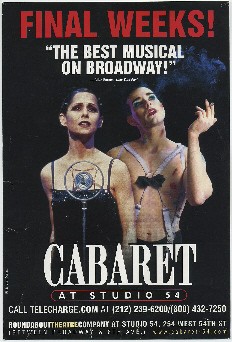
Cabaret is a musical with a book by Joe Masteroff, music by John Kander and lyrics by Fred Ebb. The 1966 Broadway production became a hit and spawned a 1972 film as well as numerous subsequent productions. It is based on John Van Druten’s 1951 play I Am a Camera, which in turn was adapted from the novel Goodbye to Berlin by Christopher Isherwood. Set in 1931 Berlin as the Nazis are rising to power, it focuses on nightlife at the seedy Kit Kat Klub and revolves around the 19-year-old English cabaret performer Sally Bowles and her relationship with the young American writer Cliff Bradshaw. A sub-plot involves the doomed romance between German boarding house owner Fräulein Schneider and her elderly suitor Herr Schultz, a Jewish fruit vendor. Overseeing the action is the Master of Ceremonies at the Kit Kat Klub which serves as a constant metaphor for the tenuous and threatening state of late Weimar Germany throughout the show.
History
Sandy Wilson, who had achieved success with The Boy Friend in the 1950s, had completed the book and most of the score for Goodbye to Berlin, his musicalization of I Am a Camera, when he discovered producer David Black’s option on both the 1951 Van Druten play and its source material by Christopher Isherwood had lapsed and been acquired by Harold Prince. Prince commissioned Joe Masteroff to work on the book, and when the two men agreed Wilson’s score failed to capture the essence of late-1920s Berlin, John Kander and Fred Ebb were invited to join the project. The new version was initially a dramatic play preceded by a prologue of songs describing the Berlin atmosphere from various points of view. As the composers began to distribute the songs between scenes, they realized the story could be told in the structure of a more traditional book musical, and they replaced some of the songs with tunes more relevant to the plot. Isherwood’s original characters began to change as well. The male lead became an American writer who teaches English; the anti-Semitic landlady was transformed into a tolerant woman with a Jewish beau, Herr Schultz, who owned a fruit store; two language students were eliminated; and two loathsome but integral characters - prostitute Fräulein Kost and Nazi Ernst Ludwig - were added to the mix. The musical ultimately became two separate stories in one, the first a revue centered on the decadence of the seedy Kit Kat Club, the second a story set in the real world in which the club existed.
After seeing one of the last rehearsals before the company headed to Boston for the pre-Broadway run, Jerome Robbins suggested the musical sequences outside the cabaret be eliminated. Although Prince ignored his advice, Bob Fosse did just that when he directed the film adaptation. In Boston, Jill Haworth struggled with her characterization of cabaret performer Sally Bowles. She was a blonde dressed in a white dress that suggested senior prom more than tawdry nightclub. Prince’s staging was unusual for the time. As the audience filled the theater, the curtain was already up, revealing a stage containing nothing but a large mirror reflecting the auditorium. There was no overture; instead, a drum roll and cymbal crash led into the opening number. The juxtaposition of dialogue scenes with songs used as exposition and separate cabaret numbers providing social commentary was a novel concept that initially startled the audience, but as they gradually came to understand the difference between the two, they were able to accept the reasoning behind them.
Productions
Original Broadway Production
After 21 previews, the original Broadway production, directed by Harold Prince and choreographed by Ron Field, opened on November 20, 1966 at the Broadhurst Theatre, eventually transferring first to the Imperial and then the Broadway before finally completing its 1,165-performance run. The opening night cast included Jill Haworth as Sally, Bert Convy as Cliff, Lotte Lenya as Fräulein Schneider, Jack Gilford as Herr Schultz, and Joel Grey as the Emcee, with Edward Winter and Peg Murray in supporting roles. Replacements later in the run included Anita Gillette as Sally, Ken Kercheval and Larry Kert as Cliff, and Martin Ross as the Emcee.
1987 Broadway Revival
After 18 previews, the first Broadway revival, again directed by Prince and choreographed by Field, opened on October 22, 1987 at the Imperial Theatre, eventually transferring to the Minskoff to complete its 261-performance run. Joel Grey received star billing as the Emcee, with Alyson Reed as Sally, Gregg Edelman as Cliff, Regina Resnik as Fräulein Schneider, and Werner Klemperer as Herr Schultz. The song “Don’t Go” was added for Cliff’s character.
1998 Broadway Revival
The second Broadway revival was a transfer of the Sam Mendes-directed Donmar Warehouse production. Co-directed by Mendes and Rob Marshall and choreographed by Marshall, it opened after 37 previews on March 19, 1998 at the Kit Kat Klub, housed in what previously had been known as Henry Miller’s Theatre. Later that year it transferred to Studio 54, where it remained for the rest of its 2377-performance run, becoming the third longest-running revival in Broadway musical history, third only to Oh! Calcutta! and Chicago. In addition to Alan Cumming as the Emcee, the original cast included Natasha Richardson as Sally, John Benjamin Hickey as Cliff, Ron Rifkin as Herr Schultz, and Mary Louise Wilson as Fräulein Schneider.
This production featured a number of notable replacements later in the run: Jennifer Jason Leigh, Joely Fisher, Gina Gershon, Deborah Gibson, Teri Hatcher, Melina Kanakaredes, Jane Leeves, Molly Ringwald, Brooke Shields, and Lea Thompson as Sally; Michael C. Hall, Raúl Esparza, Neil Patrick Harris, Adam Pascal, Jon Secada, Norbert Leo Butz and John Stamos as the Emcee; Boyd Gaines as Cliff; Tom Bosley, Dick Latessa, Hal Linden, Laurence Luckinbill, and Tony Roberts as Herr Schultz; and Blair Brown, Polly Bergen, Mariette Hartley and Carole Shelley as Fräulein Schneider.
Mendes’ conception was a very different show than either the original production or the rather conventional first revival. The most significant change was the character of the Emcee. The role, as played by Joel Grey, in both prior incarnations, was an asexual, malevolent character in a tuxedo with rouged cheeks. Alan Cumming’s portrayal was highly sexualized, wearing suspenders (i.e. braces) around his crotch and red paint on his nipples.[3]The cabaret number “Two Ladies” was staged with the Emcee, a cabaret girl, and a cabaret boy in drag and included a shadow play simulating various sexual positions.[4] The score was entirely re-orchestrated, utilizing synthesizer effects and expanding the stage band, with all the instruments now being played by the cabaret girls and boys. The brutally satiric “Sitting Pretty”, with its mocking references to deprivation, despair and hunger, was eliminated entirely, as it had been in the film version, and replaced with “Money”. “I Don’t Care Much”, which was cut from the original production, was reinstated, and “Mein Herr” and “Maybe This Time”, written for the film adaptation, were added to the score.[4] Staging details differed as well; instead of “Tomorrow Belongs To Me” being performed by a male choir, the Emcee plays a recording of a boy soprano singing it. Most dramatic of all was in the final scene in which the Emcee removes his outer clothes to reveal a striped suit of the type worn by the internees in concentration camps on which were pinned a yellow badge (identifying a Jewish prisoner) and a pink triangle (denoting a homosexual prisoner). Other changes included added references to Cliff’s bisexuality, including a brief scene where he kisses one of the Cabaret boys.
Original West End Production
The first West End production opened on February 28, 1968 at the Palace Theatre with Judi Dench as Sally, Barry Dennen as the Emcee and Lila Kedrova as Fräulein Schneider.
West End Revivals
There have been three major London revivals: in July 1986, at the Strand Theatre [5] with Kelly Hunter as Sally, Peter Land as Cliff and Wayne Sleep as the Emcee directed and choreographed by Gillian Lynne; from December 1993 to March 1994, a critically-acclaimed limited run at the Donmar Warehouse[6]directed by Sam Mendes, with Alan Cumming as the Emcee, Jane Horrocks as Sally Bowles, Adam Godley as Cliff and Sara Kestelman as Fraulein Schneider; and in September 2006 (previews) at the Lyric Theatre directed by Rufus Norris,[7] opening with Anna Maxwell Martin as Sally, James Dreyfus as the Emcee, Harriet Thorpe as Fraulein Kost and Sheila Hancock as Fräulein Schneider (winning a Laurence Olivier Award for best supporting actress). Replacements in the cast have included Kim Medcalf and then Amy Nuttall as Sally, Honor Blackman and Angela Richards as Fräulein Schneider, Julian Clary and then Alistair McGowan as the Emcee. This production closed in June 2008 and began touring the UK in 2008 into 2009, with a regional company starring Wayne Sleep as the Emcee and Samantha Barks as Sally Bowles (later replaced by Siobhan Dillon).
2012 London Revival
A revival opened in the West End at the Savoy Theatre on 3 October 2012, following a four-week tour of the UK, including Bromley, Southampton, Nottingham, Norwich and Salford. (10) Will Young plays the Emcee and Michelle Ryan portrays Sally Bowles.[11] It was announced on 10 August 2012 that Siân Phillips, Harriet Thorpe and Matt Rawle will also be joining the cast. The production brings together the creative team behind the 2006 London revival, but they have been given a chance to re-imagine the show, with different set, lighting, costumes, choreography and direction. The 2012 revival focuses more on the comical aspects of the piece, but still forces the harshness of 1931 Germany. (12)
2014 Broadway Production
A New Revival opened on Broadway at Studio 54, with Alan Cumming(“The Good Wife,” Roundabout’s The Threepenny Opera) reprises his Tony®-winning performance as the Emcee in Sam Mendes (Skyfall, American Beauty) and Rob Marshall’s (Nine and Chicago, the films) Tony-winning production of CABARET. Three-time Academy Award® nominee Michelle Williams (My Week with Marilyn, Brokeback Mountain) also stars, making her Broadway debut as Sally Bowles, alongside Tony nominees Danny Burstein (Follies) and Linda Emond (Death of a Salesman).
Alan Cumming - Emcee
Michelle Williams - Sally Bowles
Linda Emond - Fraulein Schneider
Danny Burstein - Herr Schultz
Bill Heck - Cliff
Aaron Krohn - Ernst Ludwig
Gayle Rankkin - Fraulein Kost
Other Productions
Several subsequent productions of the play have followed the Mendes version fairly closely, including a 2003 production staged in Spanish at the Teatro Nuevo Alcalá in Madrid directed by B.T. McNicholl and starring Natalia Millán as Sally (later replaced by Marta Ribera), Asier Etxeandia as the Emcee (later replaced by Armando Pita and Víctor Masán) and Manuel Bandera as Cliff (later replaced by Jesús Cabrero and Iván Campillo), and a 2005-2006 Mexican production, directed by Academy Award nominee Felipe Fernández del Paso and starring Itatí Cantoral, Fernanda Castillo, Kika Édgar and Chantal Andere in the role of Sally, and Luis Fernando Guzmán and Bruno Bichir as the Emcee. There was also a 2006 production staged in French at the Folies Bergère in Paris with Claire Perot as Sally Bowles, Fabian Richard as Emcee and Geoffroy Guerrier as Cliff, and a 2008 production at the Stratford Shakespeare Festival in Ontario. There was also the Australian Sam Mendes production in 2002 starring Toby Allen, Judi Connelli and Nadine Garner. The role of Sally was played by Tina Arena in Sydney, and Lisa McCune in Melbourne. Since May 13, 2009 a production of Cabaret is being staged in Lima, Peru at the Teatro Segura, directed by Mateo Chiarella, and starring Marco Zunino as Emcee and Gisela Ponce de León as Sally. In June 2009, Cabaret was produced by Houston’s Theatre Under the Stars for a two week engagement at the Hobby Center for the Performing Arts. Leslie Kritzer starred as Sally Bowles.[8]
In August–October 2010, Cabaret was performed at the American Repertory Theater, directed by Steven Bogart and starring singer/songwriter Amanda Palmer (formerly of the Dresden Dolls) as the Emcee.[9]
Principal characters
• The Emcee – The Emcee of the Kit Kat Club, a leering, ghoulish figure
• Sally Bowles – The headlining British singer at the Kit Kat Club
• Clifford Bradshaw – An American writer traveling through Berlin
• Fräulein Schneider – An older woman who runs the boarding house that Cliff and Sally live in
• Herr Schultz – An elderly Jewish fruit shop owner who falls in love with Fraulein Schneider
• Ernst Ludwig – A German man who befriends Cliff when he arrives in Berlin
• Fräulein Kost – A prostitute who rents in Fraulein Schneider’s boarding house
• Rosie, LuLu, Frenchy, Texas, Fritzy, and Helga – Girls who perform alongside Sally at the Kit Kat Club
• Bobby, Victor, Hans, and Herman – Cabaret boys at the Kit Kat Club
• The Nazi Youth – A young Nazi boy
• Sailors #1 and #2 – Fraulein Kost’s sailors
• Nazi Guard – Ernst’s bodyguard at the Kit Kat Club
Recordings
The first recording of Cabaret was the original cast album, with some of the songs (especially “Sitting Pretty”/”The Money Song”) heavily edited to save disk space, and others (especially “Telephone Song”) taken at a faster tempo.[citation needed] When this album was released on compact disc, Kander and Ebb’s voice-and-piano recording of songs cut from the musical was added as bonus material.
The 1972 movie soundtrack with Liza Minnelli is perhaps the best-known of the recordings, although the movie is much re-written and eliminates all but six of the original songs from the stage production.
The original London cast recording (1968) was released in the UK and reissued on the CBS Embassy label in 1973. Both the 1986 London and 1998 Broadway revival casts were recorded.
A 1999 two-CD studio recording contains more or less the entire score, including songs written for the movie or for later productions, and many incidentals and instrumentals not usually recorded. This recording features Jonathan Pryce as the Emcee, Maria Friedman as Sally, Gregg Edelman as Cliff, Judi Dench as Fräulein Schneider, and Fred Ebb as Herr Schultz.
The most recent recording of cabaret is the soundtrack of the 2006/2007 London revival at the Lyric Theatre. The recording includes James Dreyfus as emcee and Anna Maxwell Martin as Sally Bowles
In addition to these recordings, cast albums for the French, Spanish, Greek, Israeli, Italian, Austrian, Dutch, and two German productions have been released.
1. Cabaret (Original Broadway Cast)
Cabaret (Original Broadway Cast) Joel Grey, Lotte Lenya, Jill Haworth, Jack Gilford
2.Cabaret: Original Soundtrack Recording (1972 Film)
Cabaret: Original Soundtrack Recording (1972 Film) liza Minnelli Joey Grey
Musical Numbers
| Act I | Act II |
| 01 “Willkommen” Emcee, Sally, Rosie, LuLu, Frenchy, Texas, Fritzy, Helga, Bobby, Victor, Hans, Herman, and Ensemble02 “So What?” Fräulein Schneider
03 “Don’t Tell Mama” Sally, Rosie, LuLu, Frenchy, Texas, Fritzy, and Helga 04 “The Telephone Song” Company 05 “Perfectly Marvelous” Sally and Cliff 06 “Two Ladies” Emcee, Bobby, and LuLu 07 “It Couldn’t Please Me More” Fräulein Schneider and Herr Schultz 08 “Tomorrow Belongs to Me” Nazi Youth 09 “Why Should I Wake Up?” Cliff 10 “Sitting Pretty” Emcee, Rosie, LuLu, Frenchy, Texas, Fritzy, Helga, Bobby Victor, Hans, Herman, and Ensemble 11 “The Money Song” Emcee, Rosie, LuLu, Frenchy, Texas, Fritzy, Helga, Bobby, Victor, Hans, Herman, and Ensemble (1987/1998 revivals) 12 “Married” Fräulein Schneider, Herr Schultz, and Fräulein Kost 13 “Meeskite” Herr Schultz and Sally Bowles 14 “Tomorrow Belongs to Me (Reprise)” Fräulein Kost, Ernst Ludwig, and Company |
15 “Married (Reprise)” Herr Schultz and Fräulein Schneider16 “If You Could See Her (The Gorilla Song)” Emcee
17 “What Would You Do?” Fräulein Schneider 18 “I Don’t Care Much” Emcee (1998 revival) 19 “Cabaret” Sally 20 “Finale” Company
|
Video
Broadway Awards and Nominations
1967 production
• Tony Award for Best Musical (winner)
• Tony Award for Best Composer and Lyricist (winner)
• Tony Award for Best Actor in a Musical (Jack Gilford, nominee)
• Tony Award for Best Actress in a Musical (Lotte Lenya, nominee)
• Tony Award for Best Featured Actor in a Musical (Joel Grey, winner; Edward Winter, nominee)
• Tony Award for Best Featured Actress in a Musical (Peg Murray, winner)
• Tony Award for Best Scenic Design (Boris Aronson, winner)
• Tony Award for Best Costume Design (Patricia Zipprodt, winner)
• Tony Award for Best Choreography (Ron Field, winner)
• Tony Award for Best Direction of a Musical (Hal Prince, winner)
1987 revival
• Tony Award for Best Featured Actor in a Musical (Werner Klemperer, nominee)
• Tony Award for Best Featured Actress in a Musical (Alyson Reed and Regina Resnik, nominees)
• Tony Award for Best Revival (nominee)
• Drama Desk Award for Outstanding Actor in a Musical (Joel Grey, nominee)
• Drama Desk Award for Outstanding Director of a Musical (Hal Prince, nominee)
• Drama Desk Award for Outstanding Revival (nominee)
1998 revival
• Tony Award for Best Revival of a Musical (winner)
• Tony Award for Best Actor in a Musical (Alan Cumming, winner)
• Tony Award for Best Actress in a Musical (Natasha Richardson, winner)
• Tony Award for Best Featured Actor in a Musical (Ron Rifkin, winner)
• Tony Award for Best Featured Actress in a Musical (Mary Louise Wilson, nominee)
• Tony Award for Best Costume Design (nominee)
• Tony Award for Best Lighting Design (nominee)
• Tony Award for Best Choreography (nominee)
• Tony Award for Best Direction of a Musical (nominee)
• Tony Award for Best Orchestrations (nominee)
• Drama Desk Award for Outstanding Revival of a Musical (winner)
• Drama Desk Award for Outstanding Actor in a Musical (Alan Cumming, winner)
• Drama Desk Award for Outstanding Actress in a Musical (Natasha Richardson, winner)
• Drama Desk Award for Outstanding Featured Actress in a Musical (Michele Pawk, nominee)
• Drama Desk Award for Outstanding Choreography (nominee)
• Drama Desk Award for Outstanding Direction of a Musical (nominee)
• Drama Desk Award for Outstanding Orchestrations (nominee)
• Drama Desk Award for Outstanding Set Design of a Musical (nominee)
• Drama Desk Award for Outstanding Costume Design (nominee)
• Drama Desk Award for Outstanding Lighting Design (nominee)
• Theatre World Award (Alan Cumming, winner)
• Astaire Award for Best Dancer (The Kit Kat Girls & Boys: Joyce Chittick, Erin Hill, Kristin Olness, Michele Pawk, Christina Pawl, Leenya Rideout, Brian Duguay, Michael O’Donnell, Fred Rose, Bill Szobody)
Plot
Act One
At the dawn of the 1930s in Berlin, the Nazi party quietly grows stronger. The Kit Kat Klub is a seedy cabaret, a place of decadent celebration set against the backdrop of growing Nazi terror. The Klub’s Master of Ceremonies, or Emcee, together with the cabaret girls and waiters, warm up the audience (“Willkommen”). In a train station, Clifford Bradshaw, a young American writer coming to Berlin in the hopes of finding inspiration for his new novel, arrives. He meets Ernst Ludwig, a German who offers Cliff work and recommends a boardinghouse. At the boardinghouse, Fräulein Schneider offers Cliff a room for one hundred marks; he can only pay fifty. After a brief debate, she relents and lets Cliff live there for fifty marks. Fräulein Schneider observes that she has learned to take whatever life offers (“So What?”).
As Cliff visits the Kit Kat Klub, the Emcee introduces a British singer, Sally Bowles, who performs a racy, flirtatious number (“Don’t Tell Mama”). Afterward, she asks Cliff to recite poetry for her; he recites “Casey at the Bat”. Cliff offers to take Sally home, but she says that her boyfriend Max, the club’s owner, is too jealous. Sally then performs her final number at the Kit Kat Club aided by the female ensemble (“Mein Herr”). The cabaret ensemble then performs a song and dance, calling each other on inter-table phones and inviting each other for dances and drinks (“The Telephone Song”).
The next day, Cliff has just finished giving Ernst an English lesson when Sally arrives. Max has fired her and thrown her out, and now she has no place to live, and so she asks him if she can live in his room. At first he resists, but she convinces him (and Fräulein Schneider) to take her in (“Perfectly Marvelous”). The Emcee and two female companions sing a song (“Two Ladies”) that comments on Cliff and Sally’s unusual living conditions. Herr Schultz, an elderly Jewish fruit-shop owner who lives in her boardinghouse, has given Fräulein Schneider a pineapple as a gift (“It Couldn’t Please Me More”). However, in the Kit Kat Klub, a young waiter begins singing a patriotic anthem to the Fatherland (“Tomorrow Belongs to Me”) a cappella, with others joining him, including the Emcee.
Months later, Cliff and Sally are still living together and have fallen in love. Cliff knows that he is in a “dream,” but he enjoys living with Sally too much to come to his senses (“Why Should I Wake Up?”). Sally reveals that she is pregnant, but she does not know the father and reluctantly decides to get an abortion. Cliff reminds her that it could be his child, and seems to convince her to have the baby. Ernst then enters and offers Cliff a job—picking up a suitcase in Paris and delivering it to his “client” in Berlin—easy money. The Emcee comments on this (“Sitting Pretty”, or, in later versions, “Money”).
Meanwhile, Fräulein Schneider has caught one of her boarders, Fräulein Kost, bringing sailors into her room. Fräulein Schneider forbids her from doing it again, but Fräulein Kost threatens to leave. She also mentions that she has seen Fräulein Schneider with Herr Schultz in her room. Herr Schultz saves Fräulein Schneider’s reputation by telling Fräulein Kost that he and Fräulein Schneider are to be married in three weeks. After Kost leaves, Fräulein Schneider thanks Herr Schultz for lying to Kost. Schultz, however, says that he was serious, and proposes to Fräulein Schneider (“Married”).
At Fräulein Schneider and Herr Schultz’s engagement party, Cliff arrives and delivers the suitcase to Ernst. A “tipsy” Herr Schultz sings “Meeskite” (Meeskite, he explains, is Yiddish for ugly or funny-looking) a song with a moral (“Anyone responsible for loveliness, large or small/Is not a meeskite at all”). Afterward, looking for revenge on Fräulein Schneider, Fräulein Kost tells Ernst, who now sports a Nazi armband, that Schultz is a Jew. Ernst warns Fräulein Schneider that marrying a Jew may not be wise. Fräulein Kost and company reprise “Tomorrow Belongs to Me”, this time with even more overtly disturbing Nazi overtones, as Cliff, Sally, Fräulein Schneider, Herr Schultz and the Emcee look on.
Act Two
The cabaret girls, along with the Emcee in drag, perform a kick line routine which eventually becomes a goose-step. Fräulein Schneider expresses her concerns about her union to Herr Schultz, who assures her that everything will be all right (“Married” (Reprise)), but they are interrupted by the crash of a brick being thrown through the window of Herr Schultz’s fruit shop. Fräulein Schneider is afraid that the gesture might represent malicious intent, but Schultz tries to reassure her that it is just children making trouble.
Back at the Kit Kat Klub, the Emcee performs a song-and-dance routine with a girl in a gorilla suit about how their love has been met with universal disapproval (“If You Could See Her”). Encouraging the audience to be more open-minded, he defends his ape-woman, concluding with, “if you could see her through my eyes… she’s not a Meeskite at all.” (Originally, it was “She wouldn’t look Jewish at all,” which, while meant to be anti-anti-Semitic, sounded so anti-Semitic that it was changed.) Fräulein Schneider then goes to Cliff and Sally’s room and returns their engagement present, explaining that her marriage has been called off. When Cliff protests, saying that she can’t just give up this way, she asks him what other choice she has (“What Would You Do?”).
Cliff tells Sally that he is taking her back to his home in America so that they can raise their baby together. Sally protests, declaring how wonderful their life in Berlin is, and Cliff sharply tells her to “wake up” and take notice of the growing unrest around them; Sally retorts that politics have nothing to do with them or their affairs. Following their heated argument, Sally returns to the club. Cliff is accosted by Ernst who has another delivery job for him. Cliff tries to brush him off, but when Ernst asks if Cliff’s attitude towards him is because of “that Jew at the party”, Cliff attacks him – only to be badly beaten up by Ernst and his Nazi bodyguards and dragged out of the club. The Emcee introduces Sally, who enters to perform again, singing that “life is a cabaret, old chum” (“Cabaret”). As Sally finishes the song, she breaks down in tears.
The next morning, the bruised Cliff is packing, when Herr Schultz, who tells Cliff that he is moving to another boardinghouse, visits him but he is confident that the bad times will soon pass. He understands the German people, he says, because he is a German, too. When Sally returns, she reveals that she has had an abortion; Cliff slaps her. Cliff still hopes that she will join him, but Sally says that she has “always hated Paris” and hopes that when Cliff finally writes his novel, he will dedicate it to her. Cliff leaves, heartbroken.
On the train to Paris, Cliff begins to write his novel, reflecting on his experiences: “There was a cabaret, and there was a master of ceremonies… and there was a city called Berlin, in a country called Germany…and it was the end of the world.” (“Willkommen” Reprise). In the Kit Kat Klub, the Emcee once again welcomes us (in the 1998 revival, he strips off his overcoat to reveal a concentration camp prisoner’s uniform marked with a yellow Star of David and a pink triangle). The cabaret ensemble reprises “Willkommen”, but it is now harsh and violent as the Emcee sings, “Auf Wiedersehen…à bientôt”.
References
1. Mordden, Ethan, Open a New Window: The Broadway Musical in the 1960s. New York: Palgrave 2001. ISBN 0-312-23952-1, pp. 152-54 **
2. Mordden, pp. 156-57 **
3. Reice, Sylvie.”Curtain Up Review” curtainup.com, March 10, 1998 **
4.Brantley, Ben.Desperate Dance at Oblivion’s Brink“New York Times, March 20, 1998
5. Listing for 1986 revival guidetomusicaltheatre.com, accessed July 29, 2010
6. Listing for 1993 revival donmarwarehouse.com, accessed July 29, 2010
7. Listing for 2006 revival thisistheatre.com, accessed July 29, 2010
8. Hetrick, Adam.”Don’t Tell Mama“: Kritzer Begins Cabaret at TUTS June 16″ playbill.com, June 16, 2009
10. “Will Young to make West End musical debut in Cabaret”. BBC. 18 May 2012. Retrieved 17 July 2012.
11. “Michelle Ryan to join Will Young in Cabaret revival”. BBC. 25 May 2012. Retrieved 17 July 2012.
12. “Heads it’s Lia - tails it’s Kristin: The toss of a coin will decide leading lady for Harold Pinter’s revived play”. Daily Mail. 10 August 2012. Retrieved 10 August 2012.
External Links
- Cabaret at the Internet Broadway Database
- Plot and production information at the Guide to Musical Theatre
- Floormic.com Page
Category: Musical
