



42nd Street


Memorabilia Available
42nd Street
by Michael Stewart and Mark Bramble
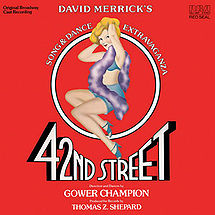
42nd Street is a musical with a book by Michael Stewart and Mark Bramble, lyrics by Al Dubin, and music by Harry Warren. The 1980 Broadway production, directed by an ailing Gower Champion and orchestrated by Philip J. Lang won the Tony Award for Best Musical and became a long-running hit. The show was produced in London in 1984 (winning the Olivier Award for Best Musical) and its 2001 Broadway revival won the Tony for Best Revival. Based on the novel by Bradford Ropes and the subsequent 1933 film adaptation, it focuses on the efforts of famed dictatorial Great White Way director Julian Marsh to mount a successful stage production of a musical extravaganza at the height of the Great Depression.
Background
The fact that before this the only movie musical adapted for the stage had been the 1974 flop Gigi did not deter producer David Merrick from taking a gamble with a $$2.5 million production.[1] He felt audiences once again were ready to embrace the nostalgia craze started by the successful revivals of No, No, Nanette, Irene, and his own Very Good Eddie several years earlier, and augmented the familiar songs from the film’s soundtrack with a liberal dose of popular tunes from the Dubin-Warren catalogue. Taking his cue from Hollywood’s Busby Berkeley, famed for his elaborate musical numbers, director/choreographer Gower Champion filled the stage with spectacular dance routines, starting with forty pairs of feet tap-dancing away as the curtain slowly rose for the first act as they did at that time.
Productions
Original Broadway
In July 1980, the musical premiered in out-of-town tryouts at the Kennedy Center for the Performing Arts in Washington, D.C. After six previews, the Broadway production opened on August 25, 1980 at the Winter Garden Theatre, eventually moving to the Majestic and then the St. James before it finally completed its 3,486-performance run, the eleventh longest run in Broadway history. (Frank Rich called this a sign of the “shift of power” on Broadway, as the show had to leave the Winter Garden to make way for Cats and the Majestic to accommodate The Phantom of the Opera.) The original cast included Jerry Orbach as Julian Marsh, Tammy Grimes as Dorothy Brock, Wanda Richert as Peggy Sawyer, and Lee Roy Reams as Billy Lawlor. Replacements later in the run included Barry Nelson, and Don Chastain as Julian, Elizabeth Allen, Dolores Gray, and Millicent Martin as Dorothy, and Lisa Brown (Nola Reardon of Guiding Light and Iva Snyder of As The World Turns) and Karen Ziemba as Peggy. The show’s designers, Robin Wagner (sets), Theoni V. Aldredge (costumes), and Tharon Musser (lights) were the same team who had designed A Chorus Line.
The opening night triumph (August 25, 1980) was overshadowed by tragedy. Following eleven curtain calls, Merrick went onstage and stated, “This is tragic,” drawing gales of laughter from the ecstatic audience. He went on to explain that Champion had died of cancer just hours before the performance, and his shocking announcement, made before an army of reporters and cameramen, drew a stunned reaction. The producer had advised only Bramble of Champion’s death and managed to keep the news a secret from the cast (including Richert, the director’s girlfriend), crew, and the public prior to his announcement. [2] In a case of life imitating art, the career of teenaged Catherine Zeta-Jones, a chorus member in the 1984 West End production, was launched when illness felled both the actress portraying Peggy Sawyer and her understudy on a night one of the producers happened to be in the audience. Zeta-Jones filled in and was impressive enough to be cast permanently in the role shortly afterward.
Broadway Revival - 2001
Bramble revised the book for and directed the Broadway revival, with choreography by Randy Skinner (dance assistant for the original production). It opened, after 31 previews, on May 2, 2001 at the Foxwoods Theatre (formerly the Ford Center for the Performing Arts), where it ran for 1,524 performances. The cast included Michael Cumpsty as Julian, Christine Ebersole as Dorothy, Kate Levering as Peggy, and David Elder as Billy. Meredith Patterson, who made her Broadway musical debut in the chorus and was the understudy for the role of Peggy Sawyer, took over the role after three months. Other notable replacements included Patrick Cassidy and Tom Wopat as Julian and Shirley Jones and Beth Leavel as Dorothy.
UK Tour - 2007
The Broadway revival production, by UK Productions, toured the UK in 2007. The cast included Paul Nicholas as Julian for the first part of the tour, later replaced by Dave Willetts, Julia J Nagle as Dorothy, Jessica Punch as Peggy and Ashley Nottingham as Billy.[3]
Asian Tour - 2007-08
An Asian tour of the Broadway revival played major venues throughout China and South Korea. An English speaking company directed by Mark Bramble. The cast included Paul Gregory Nelson as Julian, Natalie Buster as Dorothy, Kristen Martin as Peggy, and Charles MacEachern as Billy.
Regional - 2009
A new production directed by director/choreographer Randy Skinner made its debut at the Westchester Broadway Theatre in Elmsford, New York on September 24, 2009 through February 2010. A one-act condensed version played for several months at the Reno Eldorado Hotel showroom using recorded music track, closing in October 2009.
Plot
Act One
Auditions for 1933′s newest show, Pretty Lady, are nearly over when Peggy Sawyer, fresh off the bus from Allentown, Pennsylvania, arrives in New York City with valise in hand. Billy Lawlor, already cast as one of the juvenile leads, notices Peggy and hopes to charm her into accepting a date with him. He informs her she has missed the audition but he can help her bypass that process, but choreographer Andy Lee has no time for Billy’s latest conquest and tells her, “Beat it, toots.” Embarrassed and flustered, Peggy rushes off, only to slam right into director Julian Marsh himself.
One-time star Dorothy Brock, indignant at being asked to audition for a role, is reassured by Julian that he merely wants to make sure the songs are in her key. Despite his feeling Dorothy is a prima donna past her prime, he agrees to cast her in order to get financial backing from her wealthy beau Abner Dillon. Outside of the theatre, writer Maggie and chorus girls Anytime Annie, Phyllis, and Lorraine take pity on Peggy and invite her to join them for lunch and some advice. They encourage her to show them a dance routine that is witnessed by a love-struck Julian, who decides there might be room for one more chorus girl after all.
At a pre-production party, Julian learns that Dorothy is seeing old boyfriend Pat Denning behind Abner’s back. Knowing this could destroy the show’s future, he decides to put an end to the affair. One phone call to an unsavory acquaintance and Denning is visited by a couple of thugs who convince him to break it off with Dorothy. Soon after the show’s cast heads to Philadelphia for the out-of-town tryout.
On opening night, Peggy trips and crashes into Dorothy, knocking her to the stage. Julian fires the young chorine on the spot.
Act 2
Dorothy’s ankle is broken, and the show may close. The chorus kids, certain Peggy could fill the lead role, find Julian and tell him that Peggy’s a fresh young face who can sing and dance circles around Brock. Julian decides it is worth a shot and rushes off to the train station to catch Peggy before she departs.
At Philadelphia’s Broad Street Station, Julian apologizes to Peggy and asks her to stay and star in Pretty Lady, but she responds that she has had enough of show business and wants to go home to Allentown. Dumbfounded, Julian tries to coax her with the words “Come on along and listen to the lullaby of Broadway….” After the cast joins him in the serenade, Peggy decides to accept his offer.
Forced to learn the part in two days, Peggy is on the verge of a nervous breakdown when she has an unexpected visit from Dorothy, who has been watching the rehearsals and realizes beneath her nervous exterior, Peggy is good, “maybe even better than I would have been.” She even offers a little friendly advice on how to perform the last song, “About a Quarter to Nine.”
The opening night curtain is about to rise when Julian, who is completely in love with Peggy at this point, stops by for a last minute lip-lock and pep talk in which he utters the now iconic line, “You’re going out there a youngster, but you’ve got to come back a star!” The show is a huge success sure to catapult Peggy into stardom. In addition, even though she is invited to and expected to attend the official opening night party, Peggy decides to go to the chorus party instead. Julian is left alone on stage with only a single ghost light casting his huge shadow on the back wall. He quietly begins to sing, “Come and meet those dancing feet on the avenue I’m taking you to… 42nd Street.”
Characters
Billy Lawlor – Leading tenor in Pretty Lady
Peggy Sawyer – Nervous but enthusiastic new chorus girl from out of town
Julian Marsh – Famous, but notorious, director
Dorothy Brock – Past her prime Prima Donna, renowned for inability to dance
Abner Dillon – Producer of “Pretty Lady”; Dorothy’s “Sugar Daddy” and Texan admirer
Pat Denning – Dorothy’s former stage and romantic partner
Andy Lee – Choreographer/Dance Director
Bert Barry and Maggie Jones – Producers and writers of Pretty Lady
Oscar – Onstage rehearsal pianist for the show “Pretty Lady”
Mac – Stage Manager
Ann Reilly (“Anytime Annie”)
Lorraine Flemming, Phyllis Dale, and Gladys – Experienced chorus girls who help Peggy
Run
|
Opening & Closing Dates
|
Type & Version
|
Theatre
|
|
Aug 25, 1980 - Jan 8, 1989 |
Musical,Original, Broadway |
Winter Garden, Majestic, St. James Theatre,USA |
|
Aug 08 1984-Jul 01 1989 |
Musical, |
Theatre Royal, Drury Lane London, UK |
|
May 2, 2001 - Jan 2, 2005 |
Musical / Revival |
Ford Center for the Performing Arts, NY, USA |
Musical Numbers
1980 Production
Act One
“Overture” – (Orchestra) “Audition” – (Dancers) “Young and Healthy” – (Billy and Peggy) “Shadow Waltz” – (Maggie, Dorothy, and Girls) “Shadow Waltz (Reprise)” – (Dorothy) “Go into Your Dance” – (Maggie, Peggy, Annie, Phyllis, Lorraine, and Andy) “You’re Getting to Be a Habit with Me” – (Dorothy) “Getting Out of Town” – (Maggie, Bert, Pat, and Chorus) “Dames” – (Billy and Chorus) “I Know Now” – (Dorothy and Chorus) “I Know Now (Reprise)” – (Billy) “We’re in the Money” – (Annie, Phyllis, Lorraine, Peggy, Billy, and Chorus) “Act One Finale” – (Dorothy and Orchestra)
Act Two
“Entr’acte” – (Orchestra) “There’s a Sunny Side to Ev’ry Situation” – (Annie and Chorus) “Lullaby of Broadway” – (Julian, Billy, Andy, Bert, Annie, Phyllis, Lorraine, Gladys, Maggie, Abner, and Chorus) “About a Quarter to Nine” – (Dorothy and Peggy) “Shuffle Off to Buffalo” – (Maggie, Bert, Annie, and Girls) “Forty-Second Street” – (Peggy with Dancing Company) “Forty-Second Street (Reprise)” – (Julian) “Finale Ultimo” – (Full Company and Orchestra)
2001 Revival
Act One
“Overture” “Audition” “Young and Healthy” “Shadow Waltz” “Go into Your Dance” “You’re Getting to Be a Habit with Me” “Getting Out of Town” “Dames” “Keep Young and Beautiful” “Dames (Reprise)” “We’re in the Money” “I Only Have Eyes for You” “Act I Finale
Act Two
“Entr’acte” “There’s a Sunny Side to Ev’ry Situation” “Lullaby of Broadway” “Getting Out of Town (Reprise)” “About a Quarter to Nine” “Overture to ‘Pretty Lady’/Plenty of Money and You” “Shuffle Off to Buffalo” “Forty-Second Street” “Forty-Second Street (Reprise)” “Finale Ultimo”
Video
Awards and Nominations
1980 Production
Tony Award for Best Musical (winner)
Tony Award for Best Book of a Musical (nominee)
Tony Award for Best Featured Actor in a Musical (Lee Roy Reams, nominee)
Tony Award for Best Featured Actress in a Musical (Wanda Richert, nominee)
Tony Award for Best Costume Design (nominee)
Tony Award for Best Lighting Design (nominee)
Tony Award for Best Choreography (winner)
Tony Award for Best Direction of a Musical (nominee)
Theatre World Award (Wanda Richert, winner)
Drama Desk Award for Outstanding Musical (nominee)
Drama Desk Award for Outstanding Featured Actor in a Musical (Lee Roy Reams, nominee)
Drama Desk Award for Outstanding Choreography (winner)
Drama Desk Award for Outstanding Costume Design (winner)
1984 London Production
Laurence Olivier Award for Best Musical (winner)
Evening Standard Award for Best Musical (winner
2001 Revival
Tony Award for Best Revival of a Musical (winner)
Tony Award for Best Actress in a Musical (Christine Ebersole, winner)
Tony Award for Best Featured Actress in a Musical (Kate Levering and Mary Testa, nominees)
Tony Award for Best Scenic Design (nominee)
Tony Award for Best Costume Design (nominee)
Tony Award for Best Lighting Design (nominee)
Tony Award for Best Choreography (nominee)
Tony Award for Best Direction of a Musical (nominee)
Drama Desk Award for Outstanding Revival of a Musical (winner)
Drama Desk Award for Outstanding Actress in a Musical (Christine Ebersole, nominee)
Drama Desk Award for Outstanding Choreography (nominee)
Drama Desk Award for Outstanding Set Design (nominee)
Drama Desk Award for Outstanding Costume Design (nominee)
References
1. “Floridian Renovating 42nd_Street” sptimes
2. broadwayworld listing
3. UK Productions listing for 42nd Street
4. “42nd Street History“. All Musicals. 2008. Retrieved 2008-08-09.
5. Synopsis and other information from the Musical Heaven website
6. Plot summary and character descriptions
7. Brief history of the show from the Musicals 101 website
9. Another brief profile of the show from the PBS.org website
Category: Musical
